How to review terminal commands with spaced repetition
A good review is an attempt to retrieve a command before seeing it—not another pass through notes. Here is how to make Terminaster sessions short, honest, and useful.
Reviewed by the Terminaster editorial team · Updated
What you will take away
- Attempt the answer before revealing the card.
- Judge recall quality, not whether the answer looks familiar.
- Use short sessions and let due cards set the pace.
- Edit cards that remain ambiguous after repeated reviews.
Start with the cards that are due
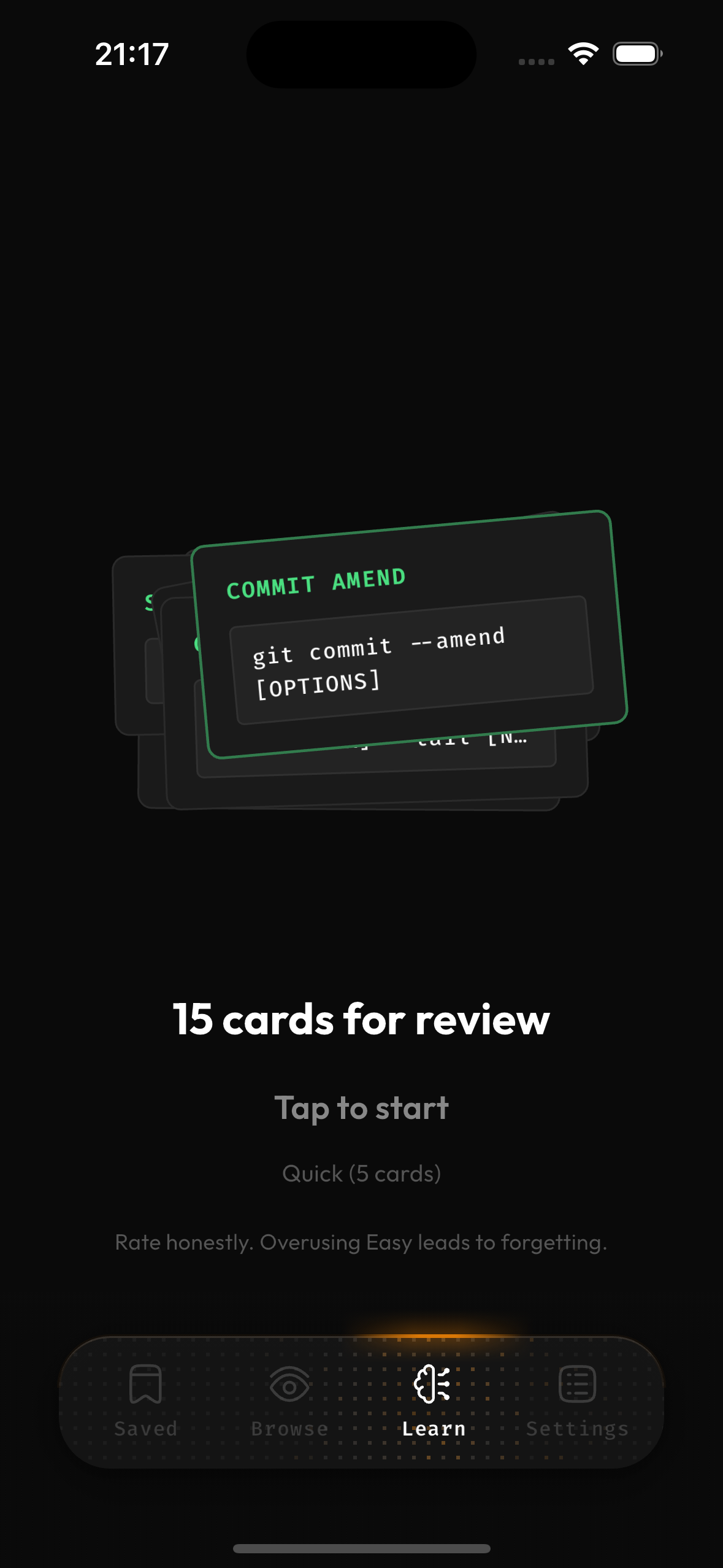
Open Learn and start a quick session when cards are waiting. Five focused reviews are useful; there is no need to clear a large queue in one sitting. The scheduler uses your ratings to decide when each card should return.
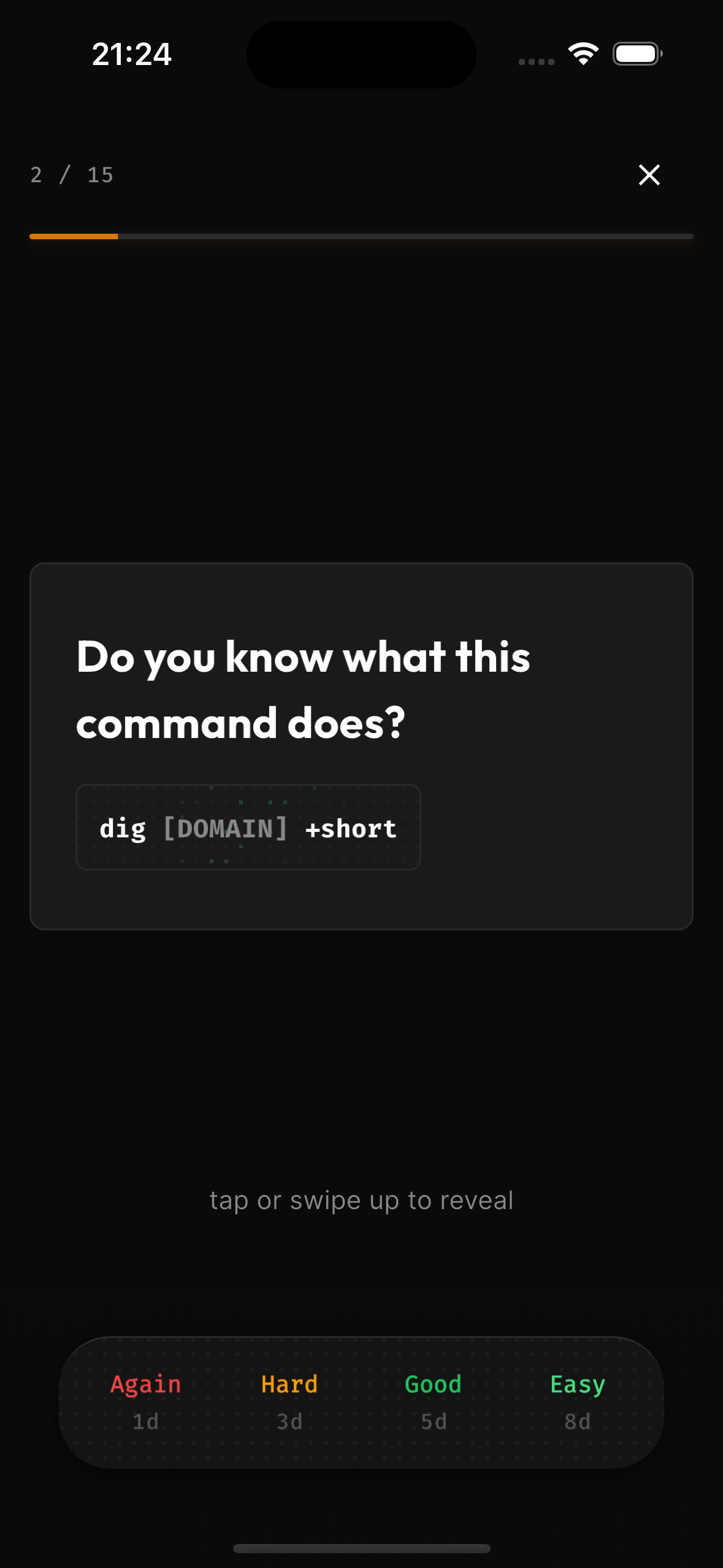
Read the prompt and pause before revealing the answer. Type or say the command, predict its effect, or name the missing flag. The exact response depends on the card, but it must happen before the reveal.
Rate the retrieval, not the feeling of familiarity
After revealing the answer, choose Again, Hard, Good, or Easy based on the attempt you actually made. Recognizing the answer after reveal is not the same as recalling it beforehand.
- Again: you did not retrieve the answer or your answer would fail the task.
- Hard: you reached it slowly, needed a meaningful hint, or missed an important detail.
- Good: you recalled the important command and behavior with reasonable effort.
- Easy: the answer was immediate and confident; use this sparingly.
Repair cards that keep failing
Repeated failure is often a card-design problem rather than a discipline problem. A card may ask for too much, omit the situation that selects the command, or contain several independent facts.
Edit the prompt so there is one clear retrieval target. Split a long pipeline into stages, keep one concrete example, and add a contrast when two similar flags are easy to confuse.
Make the prompt choose the command
Weak:  What does find do?
Better: Find every .log file under [DIR] modified in the last 24 hours.
Answer: find [DIR] -type f -name '*.log' -mtime -1
Complete the loop in a real terminal
Flashcards improve retrieval, but terminal skill also needs execution and feedback. When a reviewed command belongs to current work, run it on safe input and inspect the result. That reconnects the compact card with the real environment.
Once a week, choose one command and reconstruct a small task around it without copying the answer. If the command no longer matters, archive or delete it instead of maintaining a review queue for its own sake.
Common questions
Frequently asked questions
How many terminal command cards should I review each day?
Review the cards that are due and stop while you can still make careful attempts. A five-card session can be enough. Consistency and honest retrieval matter more than a large daily count.
When should I choose Easy?
Choose Easy only when recall was immediate, complete, and confident. If you hesitated or missed an important option, Good or Hard gives the scheduler better information.
Why do I keep forgetting the same command?
The card may be too broad, lack a concrete situation, or combine several facts. Rewrite it around one decision, split complex pipelines, and practice the command in a real terminal.
Keep learning
Sources and next steps
Related mental models
Command anatomy
A shell command is a sequence of words that identifies a command to run and supplies its options, option values, and positional arguments according to that command's interface.
Exit status
An exit status is a small integer produced when a command or pipeline completes; zero conventionally means success and nonzero meanings are defined by that command's interface.
Idempotency
An operation is idempotent when making the same intended request multiple times has the same intended effect on server state as making it once, even though individual responses may differ.