A Weekend Trip · Lesson 3 of 3
At the hotel
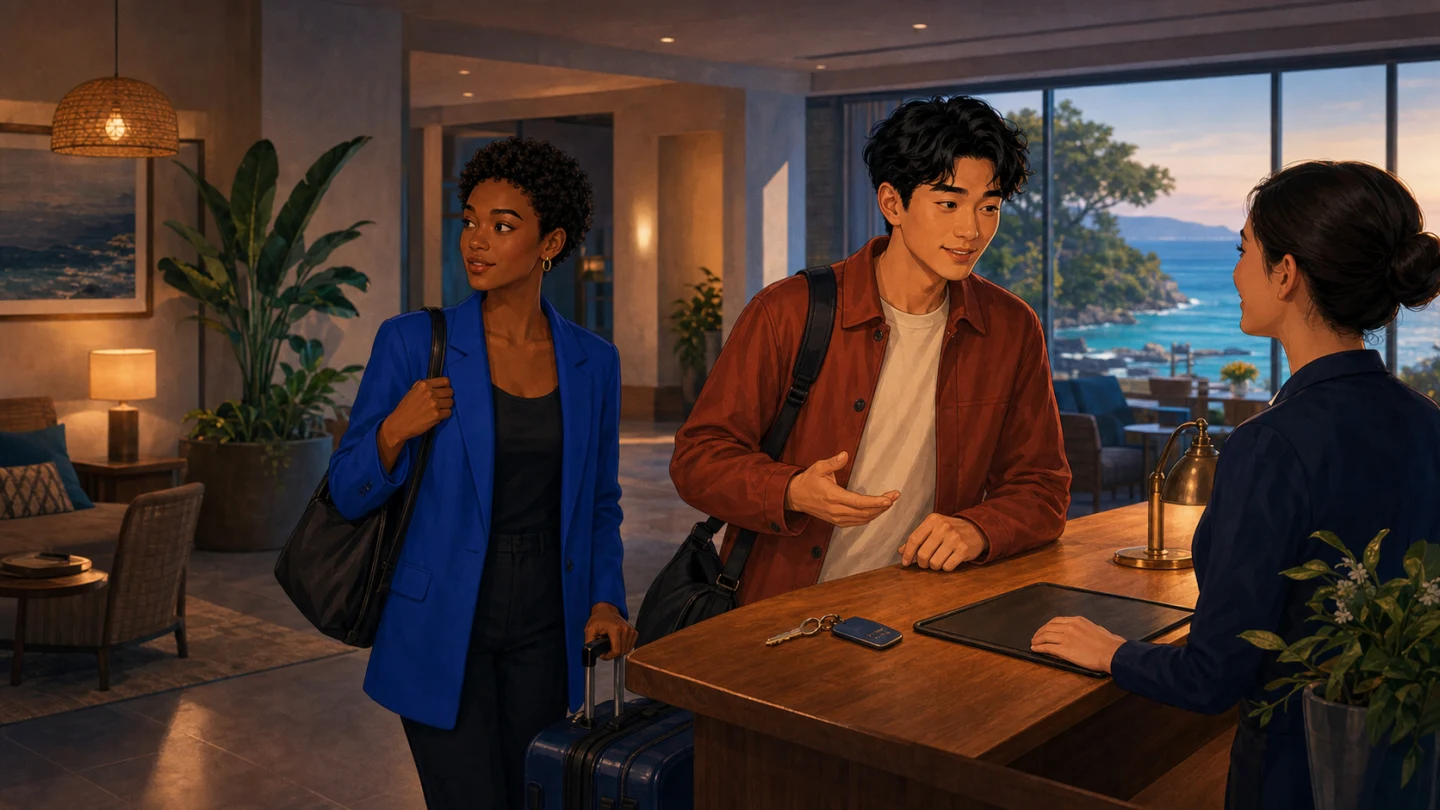
Maya and Leo arrive at their hotel by the sea. They settle into the room and enjoy their stay.
Your goal
Check into a hotel, get comfortable, and talk about enjoying and ending a stay.
By the end, you can recognise
Follow the scene
Learn the phrases in the order they happen.
Read the situation first. Then connect each phrase to the action Maya and Leo take in the story.
Story beat 1
Arrive at reception
Maya and Leo register, complete the form, and get a short tour.
“Maya and Leo checked in at the seaside hotel after their train arrived.”
In plain English: Maya and Leo registered their arrival at the seaside hotel.
+Why “in”?
A person, vehicle, message, or result reaches a place or becomes present there.
“Leo filled out the registration form at the seaside hotel.”
In plain English: Leo completed the registration form by writing the required details at the seaside hotel.
+Why “out”?
Something comes into the open. People can see it, know it, or understand it.
“The receptionist showed Maya and Leo around the seaside hotel.”
In plain English: The receptionist gave Maya and Leo a tour of the seaside hotel.
+Why “around”?
A person stays near a place or group, or moves among several places.
Story beat 2
Make yourself at home
They become comfortable, explore the hotel, and leave for the evening.
“Maya and Leo settled in at their seaside hotel before dinner.”
In plain English: Maya and Leo became comfortable at their seaside hotel before dinner.
+Why “in”?
A person, vehicle, message, or result reaches a place or becomes present there.
“Maya looked around the seaside hotel lobby while Leo spoke to the receptionist.”
In plain English: Maya looked at all parts of the seaside hotel lobby while Leo spoke to the receptionist.
+Why “around”?
Something moves in a circle, changes direction, or returns to an earlier point in a cycle.
“Maya and Leo went out for an evening walk near the seaside hotel.”
In plain English: Maya and Leo left the seaside hotel to enjoy an evening walk.
+Why “out”?
Someone leaves home to eat, meet people, or enjoy free time.
Story beat 3
Enjoy the stay
They have dinner, relax after the journey, and leave the hotel the next morning.
“Maya and Leo ate out at a small seaside restaurant near their hotel.”
In plain English: Maya and Leo had a meal at a small seaside restaurant near their hotel.
+Why “out”?
Someone leaves home to eat, meet people, or enjoy free time.
“Maya wound down in the seaside hotel after the train journey.”
In plain English: Maya relaxed in the seaside hotel after the train journey.
+Why “down”?
Strong feelings or energy become lower and calmer.
“Maya and Leo checked out of the seaside hotel after breakfast.”
In plain English: Maya and Leo paid and left the seaside hotel after breakfast.
+Why “out”?
Movement goes from inside to outside.
Check what stuck
Can you read the situation without a translation?
Choose the meaning that fits each sentence. You will get an explanation immediately, so mistakes become part of the lesson.
What does the phrasal verb mean?
“Maya and Leo checked in at the seaside hotel after their train arrived.”
Optional phrase bank
15 more phrases from this scene
The core lesson is complete. Open this bank when you want a broader vocabulary challenge.
+
Optional phrase bank
15 more phrases from this scene
The core lesson is complete. Open this bank when you want a broader vocabulary challenge.
chill out
Relax and stop being anxious
“Maya chilled out in the seaside hotel lounge before dinner.”
come back
Return to a place
“Maya and Leo came back to the seaside hotel before its front door closed.”
dress up
Put on smart or formal clothes
“Maya dressed up for dinner at the seaside restaurant near the hotel.”
get up
Move from lying or sitting to an upright or standing position
“Leo got up from the seaside hotel bed before breakfast.”
lie down
Place yourself in a horizontal position
“Leo lay down on the seaside hotel bed after the train journey.”
lounge around
Pass time in a relaxed sprawl
“Maya and Leo lounged around the seaside hotel lobby after dinner.”
sign in
Record arrival by signing
“Maya signed in at the seaside hotel desk while Leo waited with the bags.”
sleep in
Sleep later than usual in the morning
“Maya and Leo slept in on Sunday morning at the seaside hotel.”
stay up
Not go to bed at the usual time
“Maya and Leo stayed up late talking at the seaside hotel.”
step out
Leave a room or place for a short time
“Maya stepped out of the seaside hotel for a short walk.”
tidy up
Make a place neat by putting things in order
“Leo tidied up the seaside hotel room before they left.”
turn down
Fold or pull bedding so it is ready to sleep in
“A hotel worker turned down Maya's bed while she ate at the seaside restaurant.”
turn in
Go to bed for the night
“Leo turned in early at the seaside hotel after a long day.”
wake up
Stop sleeping and become conscious
“Maya woke up at the seaside hotel when she heard the gulls.”
walk around
Walk in many directions in a place
“Maya and Leo walked around the seaside hotel garden before dinner.”
Your route through A Weekend Trip
Continue the story when you are ready.
Lesson 1
Leaving home
Plan a short trip, pack what you need, and describe the start of a journey.
9 min · 9 core phrasesLesson 2
On the train
Talk about boarding a train, following the journey, and getting off at your stop.
9 min · 9 core phrases- 3
Lesson 3 · You are here
At the hotel
Check into a hotel, get comfortable, and talk about enjoying and ending a stay.
9 min · 9 core phrases

Sink In — iOS & Android
Make the phrases stay with you
Sink In connects the particle patterns behind these phrases, then brings each meaning back before you forget it.
- Learn the shared idea behind groups of phrases.
- Review with short, focused practice sessions.
- Check meaning, particle choice, and similar phrases.