Topical guide
Everyday English phrasal verbs
Everyday spoken English runs on phrasal verbs. Native speakers reach for them constantly — “I got up late, grabbed a coffee, and ended up missing the bus” is three phrasal verbs in one breath.
These are the ones you’ll hear and use most in daily life, grouped by situation, each with a natural example.
24 phrasal verbs · 3 groups
Daily routine
The verbs that narrate an ordinary day.
get up
Start the day: “I get up at seven on weekdays.”
Move from lying or sitting to an upright or standing position
eat out
Going out for food: “We don’t eat out much these days.”
Have a meal at a restaurant
hang out
Relaxed time together: “We just hung out at home.”
Spend time in a relaxed way, often with friends
carry on
Keep going: “Sorry to interrupt — carry on.”
Continue doing something
pick up
Collect, or learn casually: “I’ll pick up some milk on the way.”
Lift something off a surface
settle down
Get comfortable or calm: “Let’s settle down and watch a film.”
Become quiet and stable
catch up
Reconnect: “Let’s catch up over coffee soon.”
Reach the same level or position as someone ahead
end up
Where you finally land: “We ended up at a tiny pizza place.”
Arrive at an unintended outcome
Out & about with people
Meeting, visiting, and getting along.
get on
Have a good relationship: “Do you get on with your neighbours?”
Board a bus, train or plane
get along
Same idea, with ‘with’: “They get along like old friends.”
Have a friendly relationship with someone
come across
Find by chance: “I came across a great little café.”
Find or meet someone or something by chance
come over
Visit: “Come over whenever you like.”
Visit someone's house or place
show up
Arrive (or not): “Half the group didn’t show up.”
Arrive or appear
get away
Escape for a break: “We’re trying to get away in spring.”
Escape from a place or situation
drop by
Visit briefly: “I’ll drop by after work.”
Make a brief, casual visit
pop in
Quick informal visit: “Pop in for a coffee any time.”
Make a very short visit
Reactions & feelings
How you respond when things go well — or don’t.
cheer up
Lift someone’s mood: “Cheer up — it’s not that bad.”
Become happier or less miserable
calm down
Reduce strong feeling: “Take a breath and calm down.”
Become or make less excited or angry
get over
Recover: “It took me ages to get over the flu.”
Recover from an illness or upset
put off
Postpone, or discourage: “Don’t put it off any longer.”
Delay or postpone
look forward
Anticipate: “I’m really looking forward to the weekend.”
Feel pleased about something that will happen
give up
Stop trying: “Don’t give up — you’re nearly there.”
Stop trying; surrender
work out
Solve, or exercise: “It all worked out in the end.”
Solve a problem or calculate an answer
find out
Discover: “I just found out it’s cancelled.”
Discover information by inquiry, study or chance

Sink In — iOS & Android
Speak everyday English with confidence
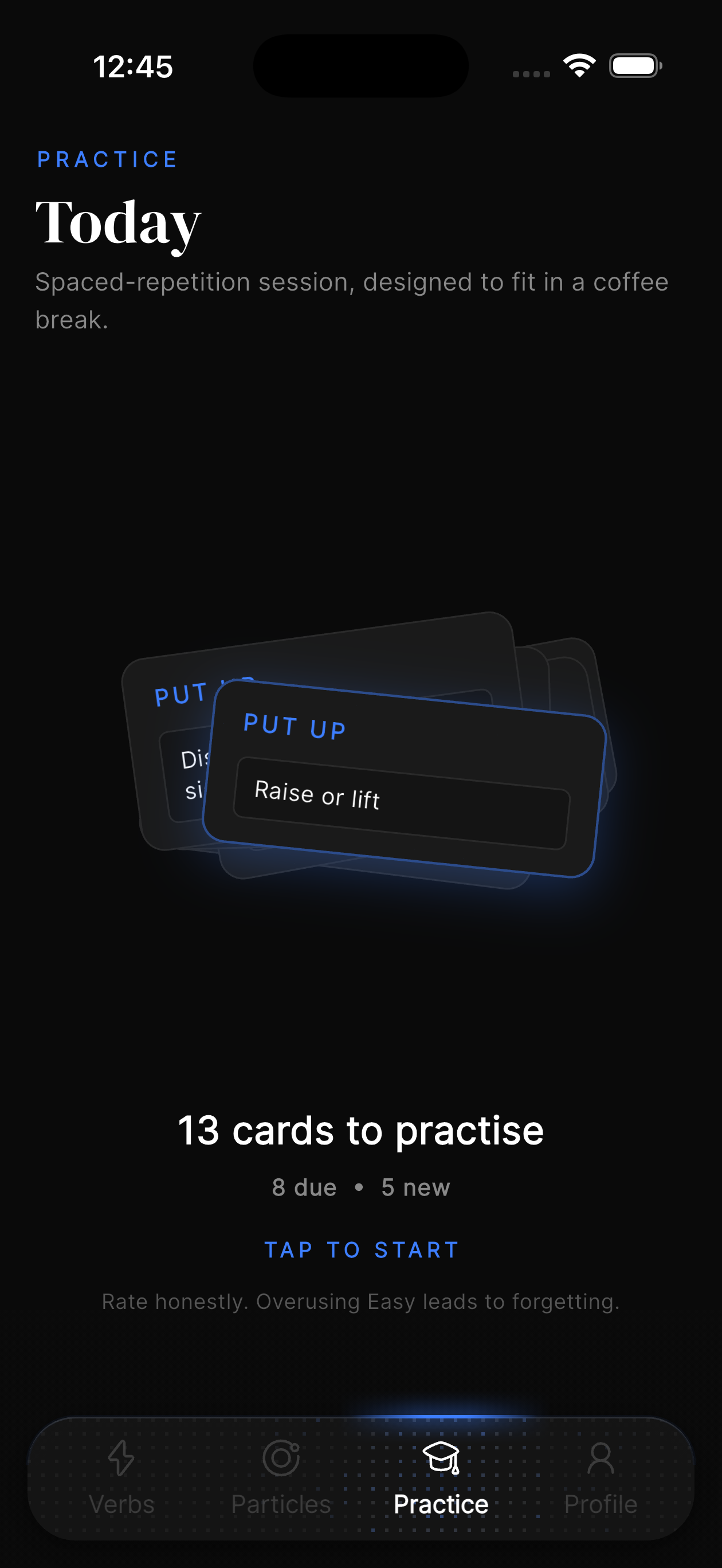
Sink In drills the phrasal verbs you hear every day — by particle pattern, with spaced repetition — so they come out without thinking.
- Learn the pattern behind dozens of verbs at once — not one-off translations.
- Spaced repetition (SM-2) brings each meaning back right before you forget.
- Four practice modes train recall and discrimination, not just recognition.