Topical guide
Business English phrasal verbs
Phrasal verbs are everywhere in business English, often the natural choice where a single formal verb would sound stiff. “Let’s go over the numbers” sounds far more native than “let us examine the numbers”.
These are grouped by the situation where they come up — meetings, getting work done, and managing projects and people — each with a note on how to use it.
24 phrasal verbs · 3 groups
Meetings & discussion
Raise points, review, and wrap up without sounding rehearsed.
bring up
Raise a topic: “I’d like to bring up the budget before we finish.”
Mention or raise a topic
go over
Review together: “Let’s go over the figures one more time.”
Move from this side to the other
point out
Flag politely: “I should point out one risk with this plan.”
Draw attention to
sum up
Close a meeting: “To sum up, we agreed on three actions.”
State briefly as a conclusion
put forward
Propose: “She put forward a strong case for hiring.”
Propose or suggest
wrap up
Finish on time: “Let’s wrap up — we’re over time.”
Bring to a conclusion
touch on
Mention briefly: “I’ll just touch on next quarter before we close.”
Mention a topic briefly
weigh up
Compare options: “We need to weigh up cost against speed.”
Carefully consider the pros and cons of something
Getting work done
Set things up, sort problems out, and see tasks through.
carry out
Formal ‘do’: “The team will carry out the audit next week.”
Perform a task or action that has been planned
set up
Arrange or establish: “I’ll set up a call for Thursday.”
Establish or arrange
sort out
Resolve: “Can you sort out the invoice issue today?”
Resolve a problem successfully
iron out
Smooth over details: “We still need to iron out the contract terms.”
Solve small problems or differences
follow through
Deliver on it: “Good idea — now we have to follow through.”
Carry an action to its proper conclusion
map out
Plan in detail: “Let’s map out the launch timeline.”
Plan something in detail step by step
zero in
Get specific: “Let’s zero in on the one blocker.”
Focus attention precisely on something
draw up
Prepare a document: “I’ll draw up a proposal by Friday.”
Compose or formulate
Projects, people & decisions
Take work on, push back, and steer the direction of a team.
take on
Accept work: “We can’t take on another client this month.”
Accept a responsibility or challenge
take over
Assume control: “She’s taking over the project from Raj.”
Assume control of something
push back
Move a date later, or resist: “Can we push back the deadline a week?”
Strongly resist or oppose an idea
focus on
Prioritise: “Let’s focus on the launch and park the rest.”
Direct attention or effort on something
cut down
Reduce: “We need to cut down on travel costs.”
Reduce the amount of something
branch out
Expand: “The firm is branching out into consulting.”
Start doing something new or different
reach out
Make contact: “I’ll reach out to the supplier today.”
Contact someone, often to offer or request help
single out
Highlight one: “The report singled out our team for praise.”
Choose one person or thing from a group for special attention

Sink In — iOS & Android
Sound natural in English at work
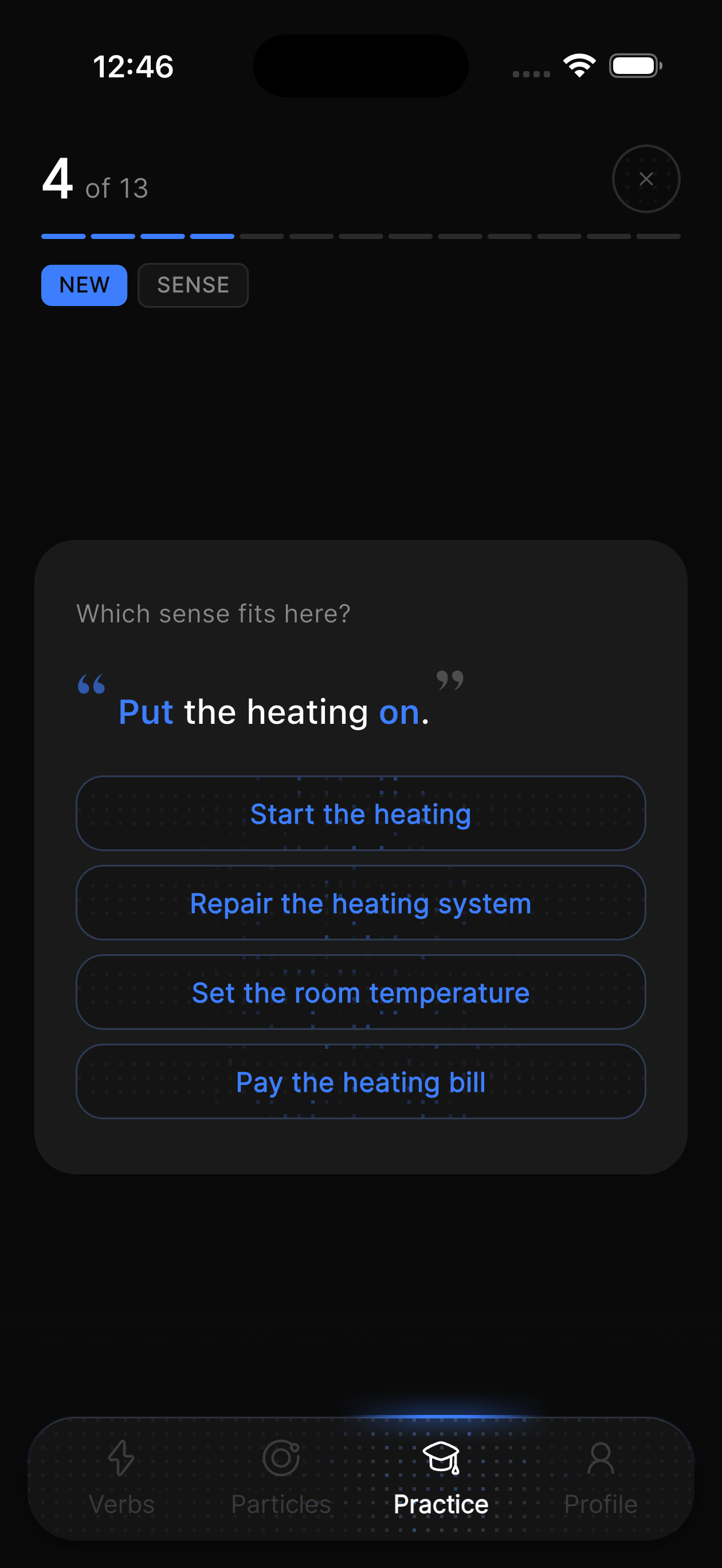
Sink In drills the phrasal verbs that come up in real meetings and email — by particle pattern, with spaced repetition — so they’re ready when you need them.
- Learn the pattern behind dozens of verbs at once — not one-off translations.
- Spaced repetition (SM-2) brings each meaning back right before you forget.
- Four practice modes train recall and discrimination, not just recognition.