Particle guide
Phrasal verbs with through
The particle through starts from one core idea — passage from one side to the other. Sink In groups its verbs by the recurring ways that idea plays out, so verbs that look unrelated line up into patterns.
55 phrasal verbs · 6 meaning groups
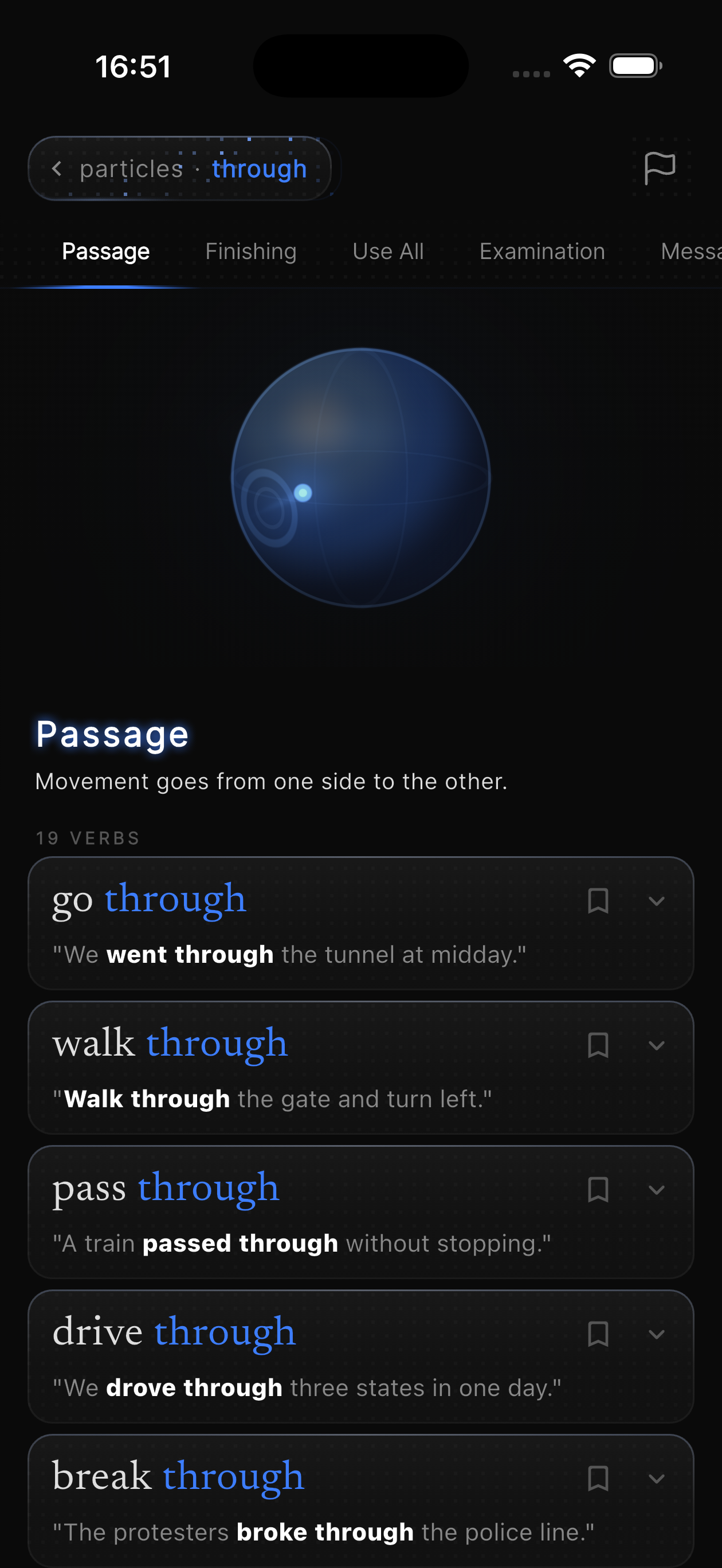
Passage
Movement goes from one side to the other.
Usual verb + particle uses
The verb keeps its normal meaning. The particle adds its usual direction or relation.
drive through
Cross by car or other vehicle
“We drove through three states in one day.”
“They drove through the desert in silence.”
pass through
Move past or between
“A train passed through the station without stopping.”
“Cold air passed through the open window.”
“Maya and Leo's train passed through three small towns before the seaside station.”
soak through
(of liquid) pass completely through fabric or paper
“The rain soaked through her coat.”
“Coffee soaked through the paper bag.”
squeeze through
Pass through a narrow space with difficulty
“He squeezed through the gap.”
“The dog squeezed through the fence.”
walk through
Cross on foot
“Walk through the gate and turn left.”
“Walk through the arch into the courtyard.”
wriggle through
Move through a narrow space with twisting body movements
“The cat wriggled through the gap.”
“The child wriggled through the narrow tunnel.”
Finishing
You start a task and continue until it is completely finished.
Use All
You move through a supply until none is left.
Examination
You check each part from start to finish.
Messages
A call or message moves through a line and reaches someone. You connect, make contact, or make the idea clear.
Endurance
You continue during a hard time until it ends.
Sink In — iOS & Android
Practice the through patterns in Sink In
The app turns each meaning group into short review cards: recognition, particle cloze, meaning-to-particle recall, and schema matching.
- Learn the pattern behind dozens of verbs at once — not one-off translations.
- Spaced repetition (SM-2) brings each meaning back right before you forget.
- Four practice modes train recall and discrimination, not just recognition.