Exam prep
Phrasal verbs for Cambridge C1 Advanced (CAE)
Cambridge C1 Advanced expects you to use phrasal verbs accurately and naturally — in the Reading and Use of English paper, in your writing, and in the Speaking test.
These are the higher-register, exam-friendly ones, grouped by where they pay off, each with a note on how examiners expect to see them used. Many are formal alternatives to single verbs like do, start, or reduce.
24 phrasal verbs · 3 groups
Use of English — formal & abstract
Higher-register verbs that work in the key-word transformation and essay tasks, where formal phrasing scores.
carry out
Formal substitute for do: carry out an investigation, a survey, a study.
Perform a task or action that has been planned
point out
Report verb for essays: “The writer points out that…”.
Draw attention to
put forward
Propose ideas formally: put forward a proposal, an argument, a theory.
Propose or suggest
single out
Select for attention: singled out for praise or criticism.
Choose one person or thing from a group for special attention
touch on
Mention briefly: “The article only touches on the causes.”
Mention a topic briefly
draw on
Use as a resource: “She draws on years of experience.”
Use a resource, knowledge or experience
set about
Begin a task: “He set about solving the problem.” — followed by -ing.
Begin a task with deliberate effort
mull over
Consider carefully: “I need time to mull over the offer.”
Think about something carefully before deciding
weigh up
Assess options: weigh up the pros and cons before deciding.
Carefully consider the pros and cons of something
Speaking & writing — natural fluency
Everyday-but-advanced verbs that make your speaking and informal writing sound effortless.
come across
Impressions: “She comes across as very confident.”
Find or meet someone or something by chance
end up
Outcomes: “A lot of graduates end up working abroad.”
Arrive at an unintended outcome
take up
Begin a pursuit: take up a hobby, a post, an offer.
Start a new hobby or activity
get away
Informal break: “a chance to get away from it all.”
Escape from a place or situation
look back
Reflective tone: “Looking back on the experience, I learned a lot.”
Think about events in the past
sort out
Resolve: sort out a misunderstanding, a problem, the details.
Resolve a problem successfully
wind down
Relax or reduce: “a way to wind down after work.”
Relax after activity
catch up
Stay current: catch up on the news, catch up with friends.
Reach the same level or position as someone ahead
Pairs examiners test
Verbs that often appear in collocation and transformation questions — learn the partners, not just the verb.
back up
Support or save: “back up your argument with evidence.”
Make a digital copy of data as a safeguard
build up
Gradual increase: build up stamina; a build-up of pressure (noun).
Gradually increase in amount, strength or intensity
cut down
Reduce: “cut down on spending.”
Reduce the amount of something
branch out
Diversify: “The company branched out into new markets.”
Start doing something new or different
iron out
Resolve small problems: iron out the details, the differences.
Solve small problems or differences
follow through
Complete what you start: “follow through on a promise.”
Carry an action to its proper conclusion
zero in
Focus precisely: “zero in on the key issue.”
Focus attention precisely on something
Sink In — iOS & Android
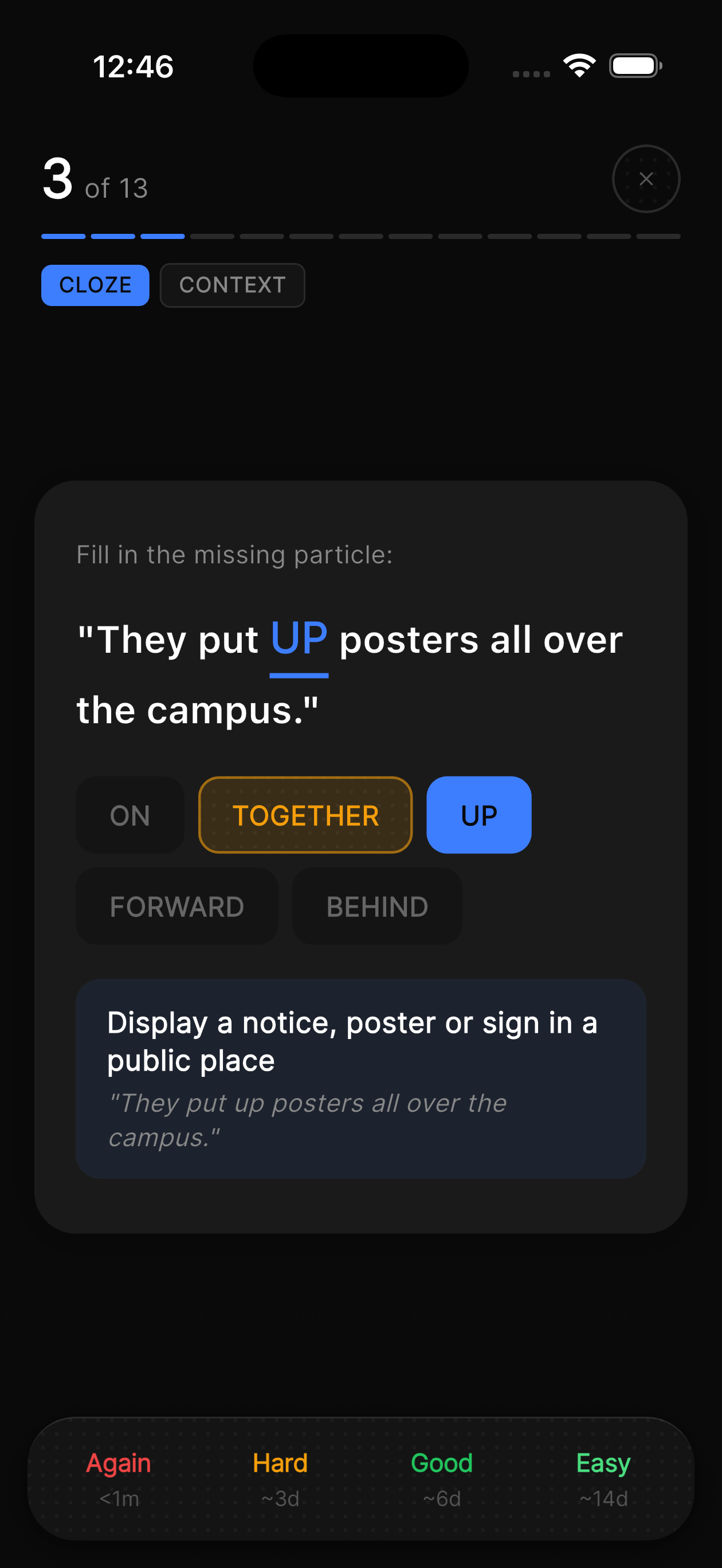
Drill C1 Advanced phrasal verbs in Sink In
Sink In schedules every meaning with spaced repetition and four practice modes, so phrasal verbs are automatic in the exam — in Use of English, writing, and speaking.
- Learn the pattern behind dozens of verbs at once — not one-off translations.
- Spaced repetition (SM-2) brings each meaning back right before you forget.
- Four practice modes train recall and discrimination, not just recognition.