How to learn phrasal verbs
The best way to learn phrasal verbs (that actually sticks)
Phrasal verbs feel random because most methods teach them as isolated translations. Here is a method that works — learn the particle pattern, then lock it in with spaced repetition.
Sink In — iOS & Android
Learn phrasal verbs the way that sticks
Sink In turns this whole method into a few minutes of practice a day — particle patterns plus spaced repetition, on iOS and Android.
- Learn the pattern behind dozens of verbs at once — not one-off translations.
- Spaced repetition (SM-2) brings each meaning back right before you forget.
- Four practice modes train recall and discrimination, not just recognition.
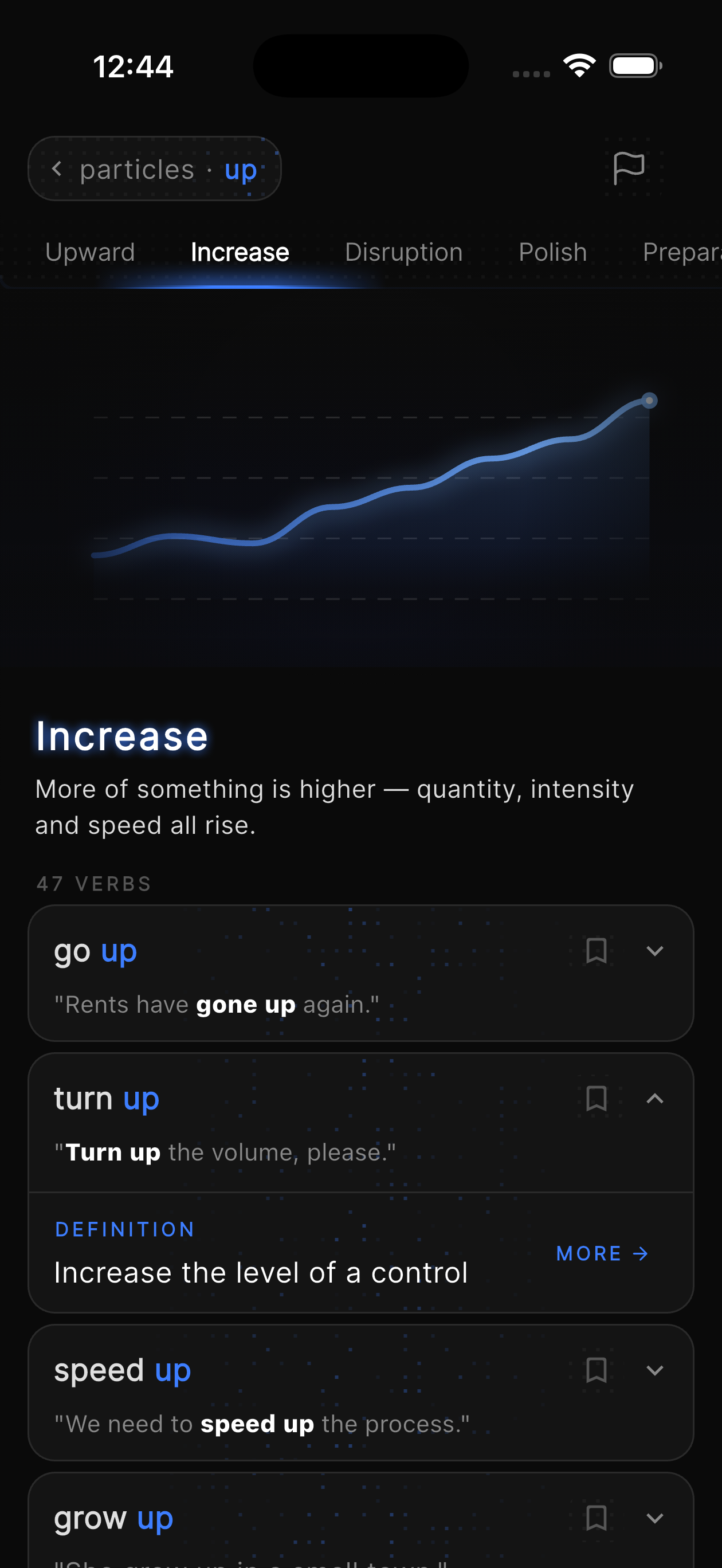
If you have tried to memorise long lists of phrasal verbs and forgotten them a week later, the problem is not you — it is the method. Lists treat every phrasal verb as a separate word to translate, so there are hundreds to learn and nothing connects them.
There is a better way. Phrasal verbs are built from a small set of particles — up, out, off, in, on, over — and each particle carries a few recurring meanings. Learn the pattern, and dozens of verbs fall into place at once.
Particle-first
Learn the pattern behind each particle — up, out, off, in — and dozens of verbs click into place together.
Spaced repetition
An SM-2 schedule brings each meaning back just before you would forget it, so reviews take minutes a day.
Four practice modes
Recognition, particle cloze, meaning-to-particle, and schema match — interleaved to train recall, not just recognition.
1. Start from the particle, not the verb
Take out. It keeps coming back to a few ideas: removal (take out, cross out), making visible (point out, find out), and finishing (sort out, run out). Once you see the shape, work out and figure out stop being random.
Pick one particle and learn its handful of meanings before moving on. You are learning a pattern that unlocks many verbs, not one verb at a time.
2. Learn whole examples, not single words
A phrasal verb means little on its own — its meaning lives in the sentence. Learn “I came across an old photo”, not just “come across = find”. The example fixes the grammar and the situation at the same time.
Pay attention to the small words: get out of the car, look forward to meeting you, give up smoking (not “to smoke”). These tiny patterns are where most mistakes happen.
3. Use spaced repetition so it sticks
Seeing a phrasal verb once is not enough. You remember something when you recall it repeatedly, just as you are about to forget — that is spaced repetition.
A good system schedules each meaning for you and brings it back at the right moment, so review takes minutes a day and nothing slips away.
4. Practise recall, not just recognition
Recognising a phrasal verb when you read it is easy; producing the right one when you speak is hard. Train the harder skill: fill in the missing particle, choose the meaning that fits the sentence, recall the verb from its meaning.
Mixing these exercise types builds the discrimination you need, so similar verbs — turn up vs turn down, get on vs get in — stop blurring together.
Frequently asked questions
How many phrasal verbs should I learn?
Start with the most common 100–200. Sink In organises 1,300+ by particle, so you can go as deep as you like — but a strong core covers most everyday English.
How long does it take?
A few minutes a day. Spaced repetition is efficient precisely because it only shows you what you are about to forget, rather than re-drilling what you already know.
Is it better than flashcards?
It uses the same spaced-repetition science as flashcards, but adds the particle patterns and four exercise types — so you build understanding and recall, not just memorised pairs.
Sink In — iOS & Android
Start with Sink In
- Learn the pattern behind dozens of verbs at once — not one-off translations.
- Spaced repetition (SM-2) brings each meaning back right before you forget.
- Four practice modes train recall and discrimination, not just recognition.